Turning The Corner (If We Can Find It)

r-avatarIn the eternal war between Plotters and Pantsers, Rune Skelley is a stalwart Plotter and ever shall be.

With that out of the way, it’s time to acknowledge one of the advantages enjoyed by our ancient adversaries: Pantsers don’t have to figure out how to switch from the planning mode into actual writing.

That’s where we are now, and it feels like looking for an address in a strange neighborhood. We know our turn is around here somewhere. We’re going slow so we can read house numbers. We’re puttering along in a strained metaphor when we should (probably?) be writing.

On the other hand, Kent observed recently that the current state of Son of Music Novel is analogous to a first draft even though there’s no manuscript per se in existence. It’s not like we’ve been spending all this time just sharpening pencils in the Writing Cave. We’ve accomplished a lot. But, without a manuscript we do not, technically, have a first draft.

The truth is, there’s no such thing as 100% preparedness. Plotters reach a point of diminishing returns when their plans hit a certain level of detail, and that’s the signal to start writing and save further optimization for the revisions stage. Recognizing that signal from the inside is not always so easy to do, and therein lies our dilemma.

This is an area where Kent’s and Jen’s personalities are perhaps too similar. We both like the planning mode, and share some of the same trepidation about leaping in on the writing too soon. If one of us was a Pantser at heart, we’d have a more balanced perspective and might vacilate less about turning this corner. Contemplating just about any other stage in the process, such an odd-couple partnership seems doomed to a lot of frustration. But maybe it can work.

Whichever banner you rally to, Pantsing or Plotting, do you think you could collaborate with a member of the other camp? Could you learn from each other? Leverage your disparate strengths? Or would it lead to a meltdown?


Georg Examined the Creatures

k-avatar

  • walking on his hands
  • like the ribs of some petrified monster
  • offering his opinion
  • chasm deeper than the Grand Canyon
  • and I know it’s not the same thing

Georg examined the creatures walking on his hands. They were not insects, as he first assumed, for they were bipedal and wore tiny little helmets on their tiny little heads. He sat in the shade of his wrecked vessel, its superstructure jutting up like the ribs of some petrified monster. On the comlink, Driscoll was offering his opinion that it would take only a few days for mission control to locate them and send rescue. But Georg knew better. Their impact had gouged out a chasm deeper than the Grand Canyon, so unless Driscoll succeeded in boosting the comlink signal for interplanetary signalling, there was no way control would expect survivors and therefore no reason for them to send anybody. The minuscule beings had trekked up his arm. One of them pointed at his face and they turned around to run back toward his hand. “Oh, no no no,” Georg murmured, “don’t run away. I was hoping we could communicate.”

“I’m not running,” Driscoll replied. Georg had forgotten his comlink was open. “But I am glad to hear you’re willing to talk. We’ll have to rely on each other to make it through this.”

“Whatever,” Georg replied. “Hey, if we do end up marooned here, and I know it’s not the same thing you said but I think we have to face it, and if we are stuck, there’s something I think you should know.”

After several silent seconds Driscoll said, “Yes?”

“We’re not alone.”

Georg slowly stood and took one careful step, moving slowly so the crowd around him had a chance to get out from underfoot.


Bonus points for using them in order

about stichomancy writing prompts

try our stichomancy writing prompt generator!

I Had Thought Myself Alone

by jen

  • alone in a small boat upon the broad Atlantic
  • crouching in frozen fear
  • unfolding the flag of the United Kingdom
  • “You don’t have to eat it.”
  • to emerge from the Caribbean

I had thought myself alone in a small boat upon the broad Atlantic when I first heard the voice coming from belowdecks. Now I huddled in the stern, crouching in frozen fear as an apparition rose through the gangway, my numb fingers unfolding the flag of the United Kingdom in a vain attempt to hide myself.

“You don’t have to eat it.”

That was all it said, over and over, in its waterlogged whisper, the terrible sound burrowing into my brain.

“You don’t have to eat it,” it said again, waving a rotten lime in my terrified face. “But if you don’t, you’ll get scurvy!”

I screamed at this sudden new vocalization for that was the moment I knew I was being haunted by Captain Archibald Bloodygums, the ghastliest sea ghost ever to emerge from the Caribbean.

If I didn’t eat the wretched lime I would incur his wrath and my little yacht would surely sink, and me with it. If I did eat it, I would join his ghastly crew for all eternity.

bonus points for using them in order

about stichomancy writing prompts

try our stichomancy writing prompt generator!


Less-Than-Perfect Telepathy

r-avatarWell, that was no fun. (But we’re feeling much better, now.)

For the new book, we’ve bestowed an odd trait on some of the characters, something that alters their subjective take on the world. As we’ve been mentioning a lot of late, the current priority is getting our ear in for the new cast. We want all the characters’ experiences to shine, but it’s crucial that this one odd trait be vivid, and that it be portrayed consistently. It’s a key piece of pseudoscience and needs to mesh with the flavor of the other speculative elements in the story world. We’re mad planners, and we like to know going in that all the edges are going to line up.

So after several conversations, and a few hours of image searches and other web research, we agreed on the basic parameters. A handful of provisional scenes were already in the can, but for a lack of that odd subjective flavor that we had just defined, so Kent went about retrofitting it.

Turned out that our agreement about the parameters was a bit of a mirage. Kent’s take went way out of bounds compared to what Jen had in mind. Of course, Kent had his reasons for doing things that way, and thought at the time that it was exactly what had been established.

This led to the conversations with no fun in them. It’s uncomfortable to be in disagreement over something you’re really invested in, and Jen and Kent don’t get a lot of practice disagreeing. (We like it that way, but it makes for extra friction when things do go south.) Both partners must seek what’s best for the fiction, and not give in for the sake of harmony. That would be false compromise, which not only hurts the quality of the writing but it also weakens the partnership over time. It’ll make you want to keep score, and you can’t keep score. You can’t carry baggage. You need to find the better answer, the thing that makes you both happy.

Which is what we did. Jen shifted to a different metaphor to articulate what she hoped to see on the page, and suddenly the vision clicked in Kent’s mind. We knew we couldn’t really say “That’s it!” until at least one scene existed incorporating the new idea, so Kent got right to work. Success!

By The Time I Was Fourteen

k-avatar

  • the virtuous among us
  • dragged him backwards
  • a number of skirmishes with Mrs Hall
  • a bonny lord and a merry one
  • I was fourteen years old

By the time I was fourteen years old, I was already a veteran of a number of skirmishes with Mrs Hall. But that was the year that I acquired an ally in the form of Consarn J Varmint, a valorous warrior and a connoisseur of acorns, and the swiftest squirrel on the block. Among his fuzzy tribe he was a bonny lord and a merry one. The others were inspired to courage by his death-defying feats.

Mrs Hall was probably a fine person in many regards, but her mania for tulips engendered savagely unreasonable behavior. If a ball or a frisbee overflew the flowerbeds she unwisely placed at the boundary of my back yard, requiring me to overfly the same flowers to retrieve the errant missile, a half-hour of apoplexy was the inevitable result. On the rare, exceedingly rare, occasions that any flowers were in fact damaged, the screaming could go on for the whole afternoon and featured threats of police involvement.

So, Consarn’s appetite for her bulbs gave me a tremendous joy, which the virtuous among us will not condemn even though it came at another’s expense. Mrs Hall turned out to be inhumanly quick, and one day caught hold of Consarn by his proud, bushy tail. She dragged him backwards through her beloved flowerbed, and I was aghast, until Consarn got sufficient traction on the lawn to arrest his retrograde movement. He sped forward as if shot from a cannon, dragging Mrs Hall up the side of an oak tree behind her garage.

about stichomancy writing prompts

try our stichomancy writing prompt generator!

Whenever She Talked About Dieter

  • by jenwhen she found out he was married
  • exaggerated his size
  • seating configuration woes
  • blue-gray vest with silvery buttons.
  • now have caught up with the Hamburger

Whenever she talked about Dieter, Brittany exaggerated his size, both in the financial and genital departments. She planned an elaborate dinner party to introduce him to her entire family. But when she found out he was married, to some hausfrau in Hamburg, the small apartment’s seating configuration woes seemed hardly worth mentioning, at least not in comparison to her vendetta.

“His lies now have caught up with the Hamburger, as has the woman he scorned,” Brittany growled. “Hell hath no fury, Dieter.”

There were tears on his blue-gray vest with silvery buttons, along with blood and sweat. Brittany had at least never had to exaggerate the size of his wardrobe.

about stichomancy writing prompts

try our stichomancy writing prompt generator!

What Color Is The Sky

r-avatarBy now, we have a fairly good handle on the background info, physical attributes, and overall personalities of all the major characters for the new novel. Jen has tracked down reference photos and filled in all the details on the character sheets. But there’s a big difference between knowing all about someone, and really knowing them.

We make use of multiple points of view in our novels, usually switching at chapter breaks and sometimes within a chapter as well. It’s third-person, but not omniscient. This goes well beyond just limiting the facts to those that the POV character could know and not letting any subjective details from the rest of the cast slip through. It’s important that each scene really convey what the world is like for that character. Being able to do that requires that we know them intimately, that they become real to us. And getting to know a bunch of people that well takes some time.

On this project, we’re making a conscious effort to mold our process around what we’ve learned on a few previous books. We really want to have the voices dialed in right from the beginning, because it sucks when you have a hundred pages of great material that’s riddled with a subtle, pervasive flaw. So we’re trying to avoid our past mistakes, like the time our readers didn’t feel connected to our protagonist (whom we absolutely loved and couldn’t get why anybody else could feel otherwise — we had neglected to put her feelings on the page) or the time we went back to the opening scene and discovered that that protagonist was behaving “out of character” (we got to know her properly only after the first part was written).

That’s not to say we had no successes, far from it. A particularly good move, which arose organically and then we recognized and formalized it, is the way we tend to divvy up scenes based on their viewpoints. This allows us to deepen our connections to certain characters, and also lets us each play to our strengths by adopting the characters that resonate with us more. There’s no rule that says “that’s a Kent character; Jen can’t write it,” and by the time we’re done there’s typically quite a bit of overlap, but as a guideline it works very well.

A few vignettes have been crafted for Son of Music Novel, things which might or might not get incorporated into the manuscript. Kent’s next project, now that there’s a bit of raw material and now that some psychoanalysis of the cast has been done, is to revise those maybe-apocryphal scenes so their POV characters’ personalities saturate them. This exercise will give us the benchmark for how the “real” scenes should feel once we begin composing the novel per se. We take a holistic view of getting the voices right. It spans all levels, from mechanicals to vocabulary to reasoning styles and even sensory inputs that are unique to each character. It’s a lot of up-front effort, but it will put us ahead of the game later on.

Go Ahead

  • who supplies noodles
    k-avatar
  • flung backwards upon the bed
  • sometimes I say the stupid things I think
  • forced to rehire an elementary school teacher
  • in the half-remodeled kitchen

Go ahead. Ask me how my day was.

You’ve never had a day like this, not unless you were forced to rehire an elementary school teacher who supplies noodles to a ring of car thieves, not unless you had to explain to the parents of that teacher’s whole class why you fired him in the first place and then announce his continued access to their children without pausing for breath. Not unless you went on to imply that those particular students had probably stolen more than a few cars themselves, so what was the harm. Not unless you then got fired, and not rehired.

Getting up this morning was a mistake. Once I was up, I should have caved in to my urges and let myself be flung backwards upon the bed in the half-remodeled kitchen. Oh, you bet your ass there’s a story behind that, but it’s too long and I’m too short of bourbon.

Sometimes I say the stupid things I think, and today I said them to the wrong people.

about stichomancy writing prompts

try our stichomancy writing prompt generator!

“For He’s a Jolly Good Fellow”

  • by jennice to see her happy again
  • nothing to do with my sister being in the room
  • in the august presence of rhombohedral crystals
  • break in his young men slowly
  • sang three little boys together

“For he’s a jolly good fellow,” sang three little boys together, in perfect, three-part harmony. The choirmaster liked to break in his young men slowly, which is why he started them off with such a banal tune. Later, in the august presence of rhombohedral crystals and all the other trappings of the pagan altar, they would face a much more difficult test of their nascent vocal talents. The choirmaster’s dedication to musical perfection had almost nothing to do with my sister being in the room, even though, as queen, she could order his execution at any moment. She has a soft spot for the choirmaster, and after all the troubles of last winter, it’s nice to see her happy again.

“Which nobody can deny!”


bonus points for using them in reverse order!

about stichomancy writing prompts

try our stichomancy writing prompt generator!

Lavishly Illustrated Plans for World Domination

r-avatarAs co-writers who work together in the textual medium, Jen and Kent are somewhat unusual. However, there are other storytelling forms wherein laboring in solitude would be the exception. In the case of film, it’s nearly unheard of for one person to create the whole thing.

We’re fascinated by other storytellers’ processes, and recently we had the chance to bask in the genius of Alejandro Jodorowsky (not in person, sadly, but still). By now you certainly have heard about Jodorowsky’s Dune, the documentary of the almost-making of the greatest movie that doesn’t exist. (No? Search it now, then come back. You’ll thank us.)

In particular, we were captivated by the book. (And here we don’t mean the novel he was adapting.)

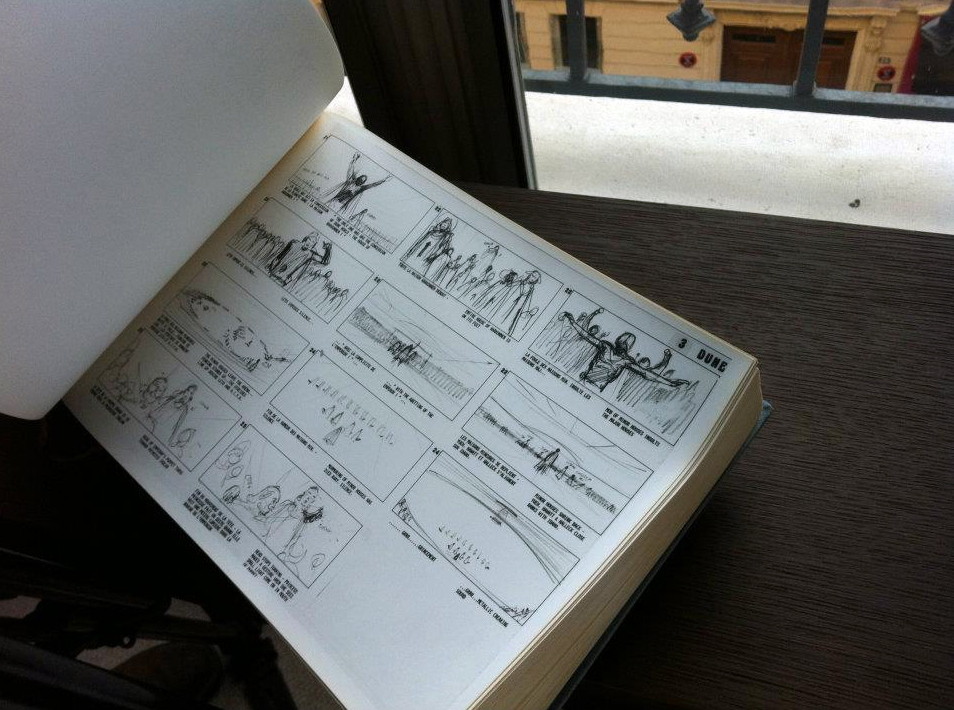
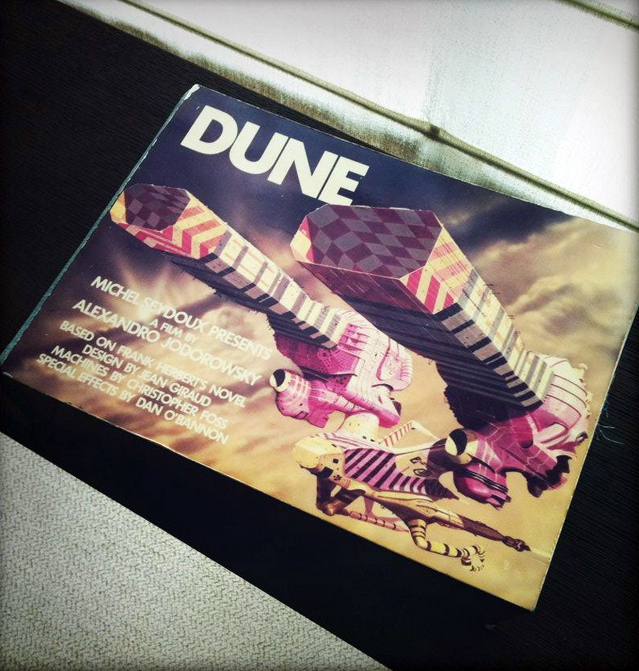
Jodorowsky compiled his team’s fabulous concept art and shot-by-shot storyboards into a mammoth book for presentation to Hollywood studios. He knew that a vision so audacious would seem unattainable, thus the meticulous (and gorgeous) documentation of how he planned to bring it about.

iu-1 iu-2

The photos don’t convey the book’s immenseness. It’s the size of a shoebox.

For Rune Skelley, Jodorowsky’s presentation book for Dune is inspirational. We have a fairly detailed (and occasionally colorful) process of our own, which is not going to seem very impressive next to what’s mentioned above. But we do put in a lot of effort up front because, when you’re working as a team, whether on a novel or a film, it’s crucial to know that you’re sharing the same vision.

In addition to the used-up steno pad, and the rainbow, and the prose outline, and the nearly-but-not-quite traditional outline, and the stubs, we also pull together piles of other notes and images that connect us to the story world.

Early in the process, we “cast” every role in the book by tracking down pictures of people who could play them. Often these are photos of famous actors, but we don’t limit ourselves when searching. These photos become incorporated into the character sheets that list out other basic data about each person in the story.

Another thing we do is “scout locations,” choosing real-world buildings to serve as templates, or sometimes to play themselves. In son-of-music novel, a family purchases a certain well known landmark mansion. Jen has been doing a little nip and tuck on the floor plan to bring it into line with the new occupants’ needs, while respecting the historical character of the structure of course.

Kent’s done a fair bit of research, most of which is classified. The most enjoyable part was putting together a gallery of fractal images and coming up with a categorization system for them. (He realizes fractals have already been categorized, but not in a way that meets Rune Skelley’s requirements.)

As with everything else about writing our books, we’re mad planners where world-building is concerned. And even when our settings resemble consensus reality — superficially — we devote the energy to make sure we can feel them under our nails.